
 Farm
Farm Industrial & construction
 OTR
OTR Turf
Turf Implement
 General
Warehousing
General
Warehousing Sea Port
 Air Port
 Construction
 Mining




Reduces Cost of Ownership

Ensures Forklift Uptime

Easy on Maintenance

Markings

Measurement
Designation

Strength

Safety
Applications

Tips

Typical Markings on
an OTR Tyre Sidewall
OTR tyre sidewalls contain important information about the tyre's size, construction, load capacity, performance and more.
EXPLORE MARKINGS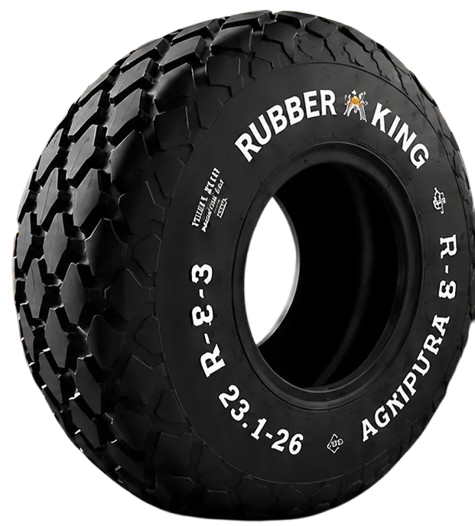
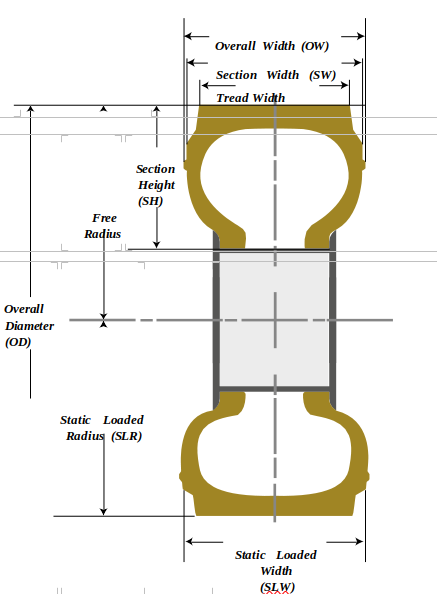
Tyre Measurement Guide
Understanding tyre dimensions helps in selecting the right tyre for your equipment and application.
Usage Designation* includes Tread Design & Tread Depth
Some tyres have dual markings which indicate that they were developed for a broader application range (example: E and L on the sidewall means the tyre can be used both for OTR machines like ADTs but also for loaders).
The letter codes are followed by a number that represents a special kind of tread design and tread depth.
Special markings on the sidewall of OTR tyres help to identify the primary usage it was designed for.
Safety and service Penumatic
Safety and service Penumatic
Safety and Service
Mounding & De mounting is recommended by Master /Expert Tyre Fitters only. Always Practice correct Inflation Pressure. Take all precautions for Safety measure.
All the Dimensions & tolerances in the Catelogue are based on Nominal T&RA and ETRTO.
To obtain best result from the tyre, Correct inflation pressure to be maintained at all the time. It is recommended to check inflation pressure always in cold conditions. It is also recommended to check inflation pressure once in a Weak. Load and inflation pressure for the OTR tyre should be determined as per the vehicle manual
A haulage cycle where the Equipment self-Load or receives a Load from the Loading equipment then transport this load to another place and returned unloaded. Transportation generally occurred over un-improved surfaces at the speed up to 65 Km /hrs and short distances up to 4 km one way. Equipment in this category is mainly Trucks and Scrappers.
A work cycle where the equipment is to pick up material and relocate it at short distance away. Tyre load fluctuate depending on the condition involved when the equipment pickups the load. Transportation speed are low, up to KM/hrs and the distances are short a maximum of 76 meter (250) ft one way.
A work cycle where the equipment Primarily intended for loader service picks up a load and transport it to another location and returns unloaded. Transportation usually occurs over unimproved surface at low speedup to 25km /hrs and rather short distances up to 600 meter (2000Feet) Equipment in this category consists mainly of LOADERS /LOG STRACKER & Material handling equipment.
A working condition where equipment is used to move materials by pushing/Dragging or grading .Tyre load are relatively constant and speed are low up to 10 km /hrs.Travel distance vary depending on work situation.
A working condition where equipment is used in construction and road maintenance. Tyre load are relatively constant during the work cycle. Equipment speed are slow during working periods with maximum speed of 40 km /hrs. Travel distance vary depending on work situation.
Need Expert Advice?
Our experts are here to help you choose the right tyre for your application.
CONTACT OUR EXPERTSExplore our complete range of OTR tyres.
DOWNLOAD NOWCarcass Strength: Star Rating & Ply Rating
Load-Carrying Capacity of Pneumatic Tyres
- Air volume inside the tire
- Inflation pressure
These factors depend heavily on the carcass design, which holds the compressed air.
Importance of Carcass Design
- The carcass is the structural body of the tire that retains compressed air.
- A stronger carcass can hold more air at higher pressures, resulting in a higher load-carrying capacity.
- At the same time, the carcass must be flexible enough to absorb shocks, which is especially important in Off-The-Road (OTR) applications.
Cross-Ply (Bias) Tires
- The carcass is made of rubber-coated fabric layers, called plies.
- The strength of a cross-ply tire carcass is rated using Ply Ratings (PR).
- Tire size
- Ply rating
- Application (e.g., for loaders)
These factors determine the maximum inflation pressure of the tire.
Radial OTR Tires
- The carcass consists of a single steel layer running radially across the tire.
- The strength of the radial carcass, and thus the load capacity, is indicated by the star marking (★).
- More stars indicate a stronger carcass and higher load capacity.
HANDLING & STORAGE
TYRE TRANSPORTATION
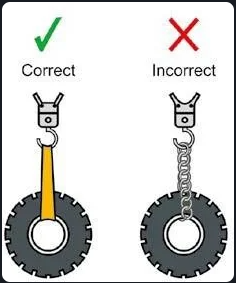
RUBBER KING TYRE PVT LTD TYREs are built for tough agricultural and industrial use. Off-Highway TYREs are often heavy and must be transported carefully to avoid damage—especially to the bead, as even minor damage can lead to air leaks, underinflation, or TYRE failure.
- Never lift the TYRE using a crane hook on the bead.
- Use wide fiber straps, rubber slings, or special lifting belts.
- Avoid ropes, steel slings, or chains.
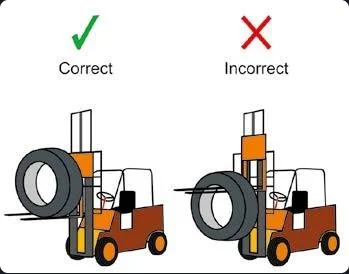
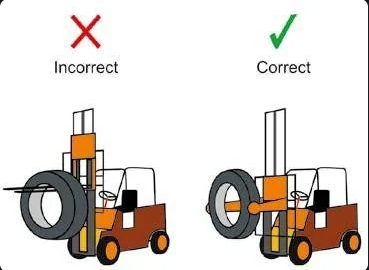
- When using a forklift, lift from under the tread—not the bead.
TYRE STORAGE
Whatever your field of application is – agriculture, earthmoving, industry, or else - Off-Highway TYREs are to be stored in a cool and dry place, away from direct sunlight, electric motors, oils, fuels, resins and other volatile substances in order to avoid any alteration of the chemical-physical features.
Should this not be possible, at least protect your TYREs with a waterproof tarpaulin to avoid contact with ultra-violet rays and bad weather.
TYREs are to be placed vertically side by side. Do not stack one TYRE over the other horizontally.
Tubes and o-rings must be stocked in their original packing or stored unwrapped on racks or shelves, but never suspended.
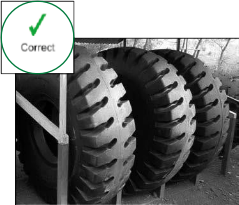
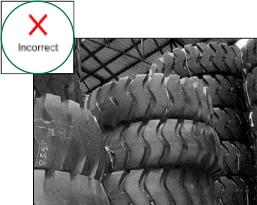
Key recommendation for Storage
- Store tyres upright in cool, dry, shaded environments.
- Avoid oil, grease, fuel, and ozone exposure.
- Don’t stack or hang heavy tyres improperly.
| Type of Vehicle | Utility | Maximum speed | Maximum distance |
|---|---|---|---|
| DOZER | Pushing /Dragging of Grading | 10 KM /hrs | Depends on work situation |
| LOADER | Pick up and relocate at short distance | 10 KM /hrs | 76 METERS |
| LOAD & CARRY | Pick up & Transport as a loader service | 25 KM /hrs | 600 METERS |
| GRADER | Used in Road Construction & Maintenance | 40 KM /hrs | Depends on work situation |
| Earth Movers | Self-Load or Receive a load and to transport and return | 65 KM /hrs | 8KM (Total both Side) |
TRA CODE
A TRA code is a standard classification used for OTR (Off-The-Road) and industrial tires.
- A letter (or letters)
- Followed by a number
- Sometimes followed by an additional letter or number
Meaning of the TRA Code Components
Indicates the type of machine the tire is intended for.
Indicates the tread depth of the tire.
Provides additional information about the tread pattern or intended application.
International Recognition
- The TRA code is recognized as an international benchmark.
- Validated by the following global standards organizations:
- ISO – International Organization for Standardization
- ETRTO – European Tyre and Rim Technical Organisation
- TRA – Tire and Rim Association (USA)
- JATMA – Japan Automobile Tyre Manufacturers Association
Categories of Tires (Based on TRA Code)
These categories are defined based on tire application and are shown by the first letter(s) in the TRA code:
- E – Earthmover tires
- G – Grader tires
- L – Loader and Dozer tires
- C – Compactor tires
- IND – Industrial tires (Port)
The following digit represents the tread depth:
Finally, if this is followed by another letter, this will say something about the tyre's pattern:
Tyre Maintenance Tips-OTR tyre
01 Proper Tyre Selection
- Choose tyres that match the application, terrain, and load requirements.
- Consider tread pattern, ply rating, and compound based on jobsite conditions.
02 Correct Inflation Pressure
- Always maintain manufacturer-recommended inflation pressure.
- Under-inflation → heat build-up, sidewall damage.
- Over-inflation → reduced traction, increased wear in center tread.
- Use digital gauges and monitor pressure regularly (ideally daily).
03 Regular Inspections
- Cuts, cracks, punctures
- Sidewall bulges
- Uneven wear
- Foreign object damage
Perform both visual and tactile inspections (touch can reveal hidden bulges or cuts).
04 Proper Mounting/Demounting
- Use trained personnel with proper tools.
- Ensure rims are clean, undamaged, and compatible with tyre specs.
- Always follow safety protocols—OTR tyres can be dangerous under pressure.
05 Alignment and Balancing
- Misalignment causes irregular wear and reduces tyre life.
- Check axle alignment regularly.
- Balance tyres if high-speed operations or excessive vibrations are noticed.
06 Load Management
- Avoid overloading—excessive loads increase tyre stress and heat.
- Distribute load evenly across axles.
- Use payload monitoring systems when possible.
07 Speed Control
- Excessive speed causes overheating and premature wear.
- Stick to recommended speed limits based on tyre and jobsite specs.
08 Rotation and Positioning
- Rotate tyres regularly to promote even wear.
- Track tyre positions and usage with a tyre management system.
- Use less-worn tyres in steer positions and more-worn in non-drive positions, depending on wear pattern.
09 Surface Condition Maintenance
- Maintain haul roads: reduce sharp rocks, potholes, and spillage.
- Smoother surfaces = less tyre damage and heat buildup.
10 Temperature Monitoring
- Use tyre pressure monitoring systems (TPMS) to track temperature and pressure.
- Overheating is a major cause of tyre failure in OTR operations.
11 Record-Keeping
- Maintain detailed records of tyre inventory, usage, repairs, rotation, and pressure logs.
- Analyze data to improve tyre performance and lifespan.
12 🔁 Additional Tips
- Train operators on good driving habits—smooth operation increases tyre life.
- Apply tyre sealants or liners in high-risk environments to prevent punctures.
- Partner with tyre service providers for periodic assessments.
Tyre Maintenance Tips- Tractor Tyres
Regular maintenance is key to prolonging the lifespan and performance of tractor tyres. Ensure proper tyre pressure, as it improves traction, fuel efficiency, and prevents uneven wear. Inspect tyres for damage such as cuts, bulges, or punctures, and address any issues promptly. Rotate tyres regularly to promote even wear and extend their life. Monitor tread depth to maintain optimal traction, especially in wet conditions, and replace tyres when tread is significantly worn. By prioritizing maintenance, you can enhance tyre longevity and performance.
Steps for Maintaining Tractor Tyres
Proper tractor tyre maintenance is essential for longevity and performance. Regularly inspect tyres for damage, such as cuts or punctures, and maintain recommended tyre pressure for even wear. Avoid overloading the tractor and minimize sharp turns or sudden stops to prevent uneven wear. Ensure proper wheel alignment to distribute load evenly and maintain traction. Clean tyres regularly to remove debris that could cause damage. Following these steps will help improve tyre lifespan and performance.
Common Issues with Tractor Tyres and How to Fix Them
Common tractor tyre issues include punctures, uneven wear, tread damage, and sidewall damage. To fix punctures, locate the hole and use a patch kit. For uneven wear, check and adjust tyre alignment, and avoid overloading. Replace tyres with deeper treads if the tread is worn down. Sidewall damage, caused by impacts, requires immediate tyre replacement to avoid blowouts. Regular inspections, proper alignment, tyre rotation, and correct inflation can help prevent these issues and extend tyre lifespan, saving time and money.
Tips for Prolonging the Life of Tractor Tyres
To extend the lifespan of your tractor tyres, follow these tips:
- Check tyre pressure regularly: Proper inflation prevents uneven wear and damage.
- Rotate tyres: Regular rotation ensures even weight distribution and minimizes wear.
- Avoid excessive loads: Stick to recommended load limits to prevent strain and damage.
- Monitor tread depth: Replace worn tyres to maintain traction and safety.
- Store tyres properly: Keep spare tyres in a cool, dry place away from sunlight.
- Protect from UV rays: Use tyre covers to shield from sun exposure and prevent degradation.
These practices help maintain tyre performance and longevity.
Key Recommendations
- Tyre mounting / De-mounting should be done by trained personnel using proper tools & methods
- Protect tyre from direct heat, Sunlight, Petrol, Oil , Grease etc.
- Maintain proper/recommended inflation pressure.
- Check tyre pressure once in 15 days with accurate gauge.
- Maintain proper Hydro inflation (Water Ballasting) for greater Draw Bar Pull, reduce wheel slippage and improve tyre life.
- Always use Valve dust caps and quality Valve cores.
- For Haulage, increase pressure corresponding to the load imposed on the tyre.
- Increase drive wheel tyre pressure by 4 PSI for land and field leveling operation.
- To carry load choose suitable trolley with proper tyre size & number of axles.
- To carry more load rear Tractor tyres must be ballasted with extra weight to prevent slippage of rear Tractor tyres.
- The hitch of the trolley should be parallel to road & app.. 16inches from ground level.
- There should not be any play between the hitch block & the pin after fixing the hitch to the Tractor or else there will be uneven & fast wear in the Tractor rear tyres.
- In case of any external cut, the tyre must be repaired immediately & always use a cold patch.
- Never use a gaiter in a tyre.
TYRE LIFE & FAILURE
In agricultural and off-highway use, Tyres may need better traction. Liquid ballasting—filling TYREs with liquid—can improve grip, stability, and lateral stiffness. Only fill up to 75% of the TYRE volume, leaving 25% for air to maintain elasticity. Inflate to the manufacturer’s recommended pressure based on load. In cold climates, use anti-freeze solutions like calcium or magnesium chloride to prevent freezing. Always have a qualified professional handle the process for safe