Rubber King

Menu
🛒 Cart (0)

No products in the cart.

Follow us
Rubber King | Know Your Tyre

Know Your Tyre

Understanding OTR Tyres Made Simple

Pneumatic OTR tyres are specifically designed to operate in challenging environments such as construction sites, mines, quarries, and large-scale industrial operations. Unlike regular tyres, these are built to endure extreme loads, resist punctures, and provide maximum traction on loose, uneven, or muddy terrain.

What Makes Rubber King OTR Tyres Special?
Sidewall
Markings
Tyre
Measurement
Usage
Designation
Carcass
Strength
Tyre Care &
Safety
OTR
Applications
Maintenance
Tips
FAQs
01 ──

Typical Markings on
an OTR Tyre Sidewall

OTR tyre sidewalls contain important information about the tyre's size, construction, load capacity, performance and more.

EXPLORE MARKINGS
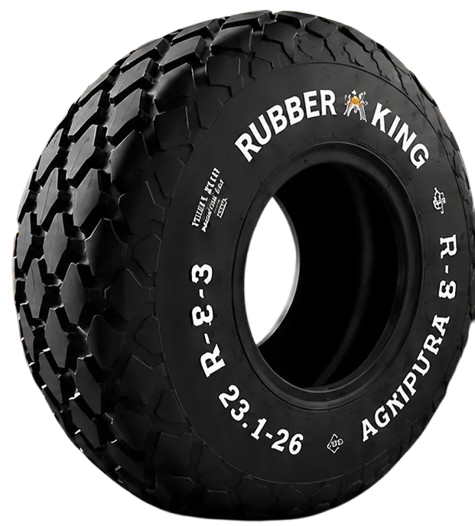
1 Tyre Size
2 Type of Construction
3 Ply Rating (PR) or Load Range
4 Tread Pattern Code
5 Load Index & Speed Rating
6 Brand and Sub Brand Name
7 Serial Number
8 Tubeless or Tube Type
9 Country of Manufacture
10 Max Load & Inflation Pressure
02 ──

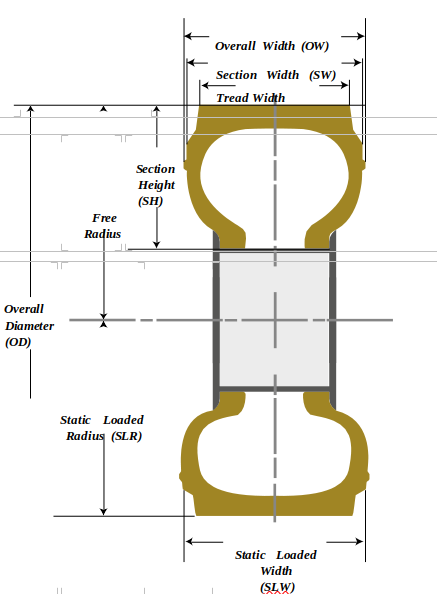
Tyre Measurement Guide

Understanding tyre dimensions helps in selecting the right tyre for your equipment and application.

Overall Diameter (OD) – This measurement is taken after the TYRE is properly mounted on the designated reference rim and inflated to the manufacturer's recommended pressure. The TYRE should be left for at least 24 hours without any load before measuring the overall diameter.
Section Width (SW) – This refers to the width of the TYRE's sidewall, excluding any protrusions such as TYRE code markings. The section width is measured once the TYRE is mounted on the reference rim, inflated to the recommended pressure, and allowed to sit for at least 24 hours without load.
Overall Width (OW) – The overall width is the maximum width of the TYRE, including any protrusions such as sidewall lettering, TYRE brand marks, and code markings. This is measured under the same conditions as the section width: mounted, inflated, and without load for at least 24 hours.
Section Height (SH) – The section height refers to the TYRE’s vertical height. It is calculated by subtracting the rim diameter from the overall diameter and then dividing the result by two.
Static Loaded Radius (SLR) – This refers to the radius of the TYRE when it is subjected to a static load, which is typically measured under specific conditions outlined by the manufacturer. This parameter represents the vertical distance between the ground and the axis of rotation of the tire. It is measured when the tire is inflated to its recommended pressure, properly mounted on its reference rim, and subjected to its maximum load as defined by the load index.
Static Loaded Width (SLW) – This parameter indicates the outer width of the tire, measured across the sidewalls. It is determined when the tire is inflated to its nominal pressure, properly mounted on its reference rim, and subjected to the maximum load as defined by the load index.
VIEW DETAILS
03 ──

Usage Designation* includes<br>Tread Design & Tread Depth

Some tyres have dual markings which indicate that they were developed for a broader application range (example: E and L on the sidewall means the tyre can be used both for OTR machines like ADTs but also for loaders).

The letter codes are followed by a number that represents a special kind of tread design and tread depth.

Special markings on the sidewall of OTR tyres help to identify the primary usage it was designed for.

Compactor
C
Earthmover e.g. Articulated Dump Truck
E
Grader
G
Highway usage e.g. Mobile Crane
H
Loader and Dozer
L
Industrial applications e.g. Reach stacker
IND
*Some tyres have dual markings (e.g., E and L) for broader applications.

Safety and service Penumatic

Safety and service Penumatic